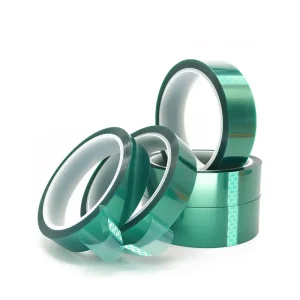
Explore precision-manufactured polyimide films, specialized composite carriers, and pressure-sensitive thermal solutions engineered for critical manufacturing environments.
A comprehensive review of molecular architecture, mechanical integrity under continuous thermal load, and dielectric breakdown mechanisms for global technology enterprises.
Polyimide (PI) film, colloquially identified by DuPont's trade designation Kapton, represents the zenith of aromatic heterocyclic polymer engineering. The alternating benzene rings linked via imide functionalities confer extraordinary structural rigidity, exceptional glass transition values ($T_g > 360^\circ\text{C}$), and high resistance to electron puncture under intense electric stress fields. Unlike conventional polyester (PET) or polyvinyl chloride (PVC) substrates that soften or degrade at modest thermal ranges, polyimide tape maintains dimensional stability across extreme spans from -269°C up to 260°C continuously, with transient exposure tolerances surpassing 350°C during wave soldering, SMT reflow, or aerospace thermal cycling.
When combined with cross-linked organosilicon (silicone) or high-grade modified thermosetting acrylic pressure-sensitive adhesive (PSA) matrices, China-formulated polyimide tape exhibits balanced viscoelastic properties. In particular, custom silicone PSA formulations maintain aggressive wet-out across diverse polar and non-polar substrates—such as untreated copper, FR-4 laminate, anodized aluminum, and nickel-plated busbars—while providing zero residue after high-temperature curing cycles.
| Physical / Electrical Property | Standard Polyimide (1 Mil PI + 1.5 Mil Adh) | Heavy Duty PI (2 Mil PI + 1.5 Mil Adh) | Anti-Static (ESD) Coated PI | Test Method |
|---|---|---|---|---|
| Total Nominal Thickness | 0.060 mm (±0.005 mm) | 0.088 mm (±0.005 mm) | 0.065 mm (±0.005 mm) | ASTM D-1000 |
| Base Film Thickness | 25 μm (1.0 mil) | 50 μm (2.0 mil) | 25 μm (1.0 mil) | ASTM D-1000 |
| Adhesive Formulation | Cross-linked Silicone | Cross-linked Silicone | Conductive/ESD Silicone | Internal Verified |
| Dielectric Breakdown Voltage | ≥ 6,500 Volts | ≥ 9,500 Volts | ≥ 6,000 Volts | ASTM D-149 |
| Tensile Strength at Break | ≥ 135 N / 25 mm | ≥ 220 N / 25 mm | ≥ 130 N / 25 mm | ASTM D-882 |
| 180° Peel Adhesion (to Steel) | 6.0 - 7.5 N / 25 mm | 6.5 - 8.0 N / 25 mm | 5.5 - 7.0 N / 25 mm | PSTC-101 |
| Surface Resistivity (ESD Side) | N/A (Dielectric Insulator) | N/A (Dielectric Insulator) | 10^6 - 10^9 Ω/sq | ASTM D-257 |
The global push for automotive electrification has transformed the procurement criteria for Kapton polyimide tapes. In contemporary lithium-ion battery modules (incorporating prismatic, cylindrical 4680, or pouch formats), dielectric isolation is mission-critical. Thin profiles are required to maintain high volumetric energy densities, while edge wrap puncture resistance and dielectric strength must resist localized dendritic short-circuits. Polyimide tape acts as an impermeable barrier against electrolyte corrosion, hydrofluoric acid traces, and mechanical abrasion from pack vibration.
China's top tier tape coaters have resolved early-generation limitations regarding adhesive creep under elevated cell discharge temperatures. By leveraging precise stoichiometric formulations between hydroxyl-functionalized polydimethylsiloxane resins and cross-linking catalysts, Huayuan provides polyimide solutions that resist thermal runaways while inhibiting flame propagation according to UL 94V-0 protocols.
How the Pearl River Delta industrial ecosystem delivers unmatched cost efficiency, scale predictability, and rapid engineering customizability for international OEMs.
Direct domestic supply channels for pyromellitic dianhydride (PMDA) and 4,4'-oxydianiline (ODA) monomers allow Chinese manufacturers to eliminate geopolitical pricing volatility. Raw polyimide film casting, thermal stretching, and polymer coating are coordinated within local industrial clusters in Guangdong.
Our dual facilities in Zhuhai and Zhongshan feature ISO Class 7/8 dust-free coating and rewinding operations. High-speed CNC slitters provide width tolerances within ±0.15 mm, with smooth edges free of micro-burrs that could cause voltage flashovers.
Every jumbo roll carries an encoded barometric log tracking coating thickness, dry-box thermal gradients, polymer cure rates, and inline optical defect scanning. Statistical Process Control (SPC) guarantees zero batch-to-batch variation.
Enterprise buyers require more than low product costs: they need supply security, international regulatory compliance, and consistent technical documentation.
Demand centers on fire-resistant cell wrapping, high-voltage busbar protection, and thermal interface cushioning. Materials must meet IATF 16949-aligned QA standards, withstand electrolyte immersion, and hold valid IMDS documentation.
Demands deep thermal vacuum performance, low outgassing characteristics compliant with ASTM E595 (%TML < 1.0%, %CVCM < 0.1%), and stable cryogenic ductility for satellite multilayer insulation (MLI) blankets.
Critical requirements include gold-finger protection during wave solder baths, clean release with zero adhesive ghosting, and low static discharge (ESD) to prevent ESD damage to sensitive microchips.
Mitigating supply risk through international quality standards, hazardous chemical controls, and engineering communication.
Certified since 2013. Standard operating procedures oversee every operational stage from raw polymer compounding to final cleanroom packing and freight palletizing.
Certified halogen-free and compliant with EU RoHS Directive 2011/65/EU and REACH (SVHC). Products are independently verified by SGS with updated test reports.
Selected insulation tapes hold formal UL yellow cards under the UL 510 standard, meeting flame retardancy and electrical isolation safety specifications.
Direct communication with chemical and applications engineers. We provide comprehensive TDS, MSDS/SDS, sample test data, and rapid DFM reviews within 24 hours.
Key technological advancements transforming pressure-sensitive polyimide adhesives over the coming decade.
Mitigating siloxane outgassing in optical, medical, and camera module packaging. Advanced modified cross-linked acrylics deliver 200°C resistance with zero risk of optical lens haze.
By blending ceramic nanoparticles (such as boron nitride and aluminum oxide) into the base polyimide substrate, films achieve thermal conductivities exceeding 0.8 to 1.2 W/m·K while maintaining high dielectric breakdown ratings.
Next-gen consumer electronics and wearable medical biosensors demand 0.5 mil (12.5 μm) and 0.3 mil base polyimide films, requiring specialized high-precision web-handling coaters to eliminate tension wrinkles.
Answers to technical, operational, and commercial questions asked by international tape converters and OEM buyers.
Kapton® is a registered trademark of DuPont. Chinese manufacturers produce polyimide films using comparable PMDA/ODA chemical synthesis pathways. Huayuan's high-grade polyimide tape delivers equivalent mechanical, thermal (260°C), and dielectric properties (≥6.5 kV), offering an engineered alternative at substantial cost savings.
Silicone adhesive withstands higher sustained temperatures (up to 260°C continuous, 300°C+ peak) and releases cleanly from copper, gold, and FR-4 with zero adhesive residue. Acrylic adhesives generally top out around 155°C–180°C, but eliminate silicone outgassing in sensitive optics and paint systems.
Yes. Our converting facility features imported rotary and flatbed die-cutting units, optical inspection, and cleanroom slitting down to custom widths from 2.5 mm up to 1000 mm. We supply kiss-cut parts on polyester liners, die-cut dots, custom pull-tabs, and private-label packaging.
We maintain an ISO 9001:2015 quality system with strict incoming raw material verification, dry-weight beta-gauge monitoring on all coating runs, and finished-roll testing for peel adhesion, holding power, and dielectric breakdown. Retained samples and batch test records are archived for each lot.
Standard log-roll and slit-roll samples are supplied free of charge within 24 to 48 hours for qualification trials. Custom die-cut prototypes typically ship within 3–5 working days. We provide flexible Minimum Order Quantities (MOQs) for both trial batches and regular container programs.
Every shipment can be accompanied by an official Certificate of Analysis (COA), SGS RoHS & REACH test reports, MSDS/SDS sheets, and UL compliance references. International trade documentation and customs handling are managed via our Hong Kong export division.
Explore our complete product catalog: high-temperature masking, double-sided acrylics, nano tapes, and transformer insulation rolls.