A comprehensive examination of continuous filament matrices, pressure-sensitive adhesive chemotypes, and structural load distribution in mission-critical electrical and thermal environments.
In modern industrial assembly, heavy electrical apparatus fabrication, and next-generation power electronics, mechanical fasteners and unreinforced dielectric films frequently encounter acute physical limits. Glass Fibre Reinforced Tape—commonly designated across global procurement channels as filament tape, cross-weave fiberglass tape, or glass cloth pressure-sensitive adhesive tape—occupies a paramount role in bridging the gap between flexible polymer insulations and rigid mechanical bracing. Manufactured through precision deposition of thermoset or elastomeric adhesives onto fiberglass woven fabrics or unidirectional filament networks, these composite solutions offer virtually unyielding tensile strength, negligible elongation under thermal load, outstanding Class B to Class H dielectric insulation, and unmatched resistance to chemical ingress.
For international tier-1 converters, motor remanufacturers, and renewable energy equipment OEMs, sourcing directly from verified wholesale glass fibre reinforced tape manufacturers is not simply an exercise in volume pricing. It is a strict mandate to safeguard supply chain velocity, guarantee microscopic consistency of coating grammage, eliminate batch-to-batch delamination, and secure comprehensive compliance with international standards such as UL 510, ASTM D1000, IEC 60454, and RoHS/REACH environmental mandates.
Unidirectional and bi-directional (cross-weave) E-glass yarn arrays provide longitudinal tensile thresholds reaching in excess of 450 N/25mm. High tensile moduli mitigate mechanical drift during transformer core banding and high-velocity electric motor rotor winding operations.
Capable of sustained Class H performance (180°C to 200°C) and Class C intermittent spikes, glass cloth carriers paired with cross-linked silicone adhesives prevent thermal carbonization, edge fraying, and dielectric puncture under severe electromagnetic fields.
From pressure-sensitive cross-linked synthetic rubber with immediate high shear tack to solvent acrylics that endure solvent varnish impregnations, each adhesive formula is engineered to prevent adhesive transfer and cold flow.
Analyzing cross-sector demands where glass fibre reinforced tapes act as structural enablers rather than auxiliary consumables.
Within lithium-ion traction battery packs, cell structural integrity under charge-discharge volumetric expansion is critical. Unidirectional glass filament tapes secure prismatic and cylindrical cell modules against vibrational cycling, providing fire-retardant containment (meeting UL 94 V-0 metrics) and high breakdown voltage exceeding 5 kV to prevent thermal runaway propagation.
Transformers endure catastrophic magnetic shear forces during electrical spikes. Glass cloth tapes infused with thermosetting adhesives maintain core coil bundling without softening under varnish baking cycles (150°C–180°C). Unlike metallic banding, fiberglass eliminates eddy-current losses, corona discharge risks, and electromagnetic interference.
Aerospace manufacturing demands masking and securing tapes that withstand autoclave curing environments at 180°C under high vacuum pressures. High-temperature glass fiber tapes provide vacuum bag sealing edge stabilization, peel plies retention, and zero-residue release on critical titanium and carbon composite airframes.
Cross-weave glass filament tapes reinforce cold-applied anticorrosion coatings on transcontinental pipelines. The bi-directional scrim provides tear resistance against backfill soil stress, aggregate puncture, and microbiological degradation in underground or marine installations.
In the construction of multi-megawatt composite turbine spars, bidirectional glass tape is utilized during vacuum-assisted resin transfer molding (VARTM) to anchor root-reinforcement plies without shifting, preserving fiber straightness essential for long-term aerodynamic fatigue endurance.
While standard polyester (PET) strapping tapes exhibit up to 15% to 25% elongation at break, E-glass reinforced tapes restrict plastic deformation to under 3.5% under peak loads. This zero-stretch profile prevents loosened coils, coil displacement, and subsequent insulation abrasion failure in alternating-current machinery.
The transformation of glass tape manufacturing from traditional packaging accessories into certified industrial substrates.
The global market for industrial adhesive tapes has shifted dramatically over the past decade. Legacy tier-1 brands in North America and Western Europe historically commanded near-monopoly margins on specialized grades like 3M 69 glass cloth tape or Nitto 188. However, an evolution in high-precision precision slitters, multi-stage hot-melt and solvent coating towers, and ISO 9001-governed cleanroom environments across specialized Chinese manufacturing clusters has altered the commercial calculus.
Today, tier-1 global converters, multinational motor rewind operations, and automotive Tier-2 suppliers source strategic volumes from certified Chinese manufacturers who can supply drop-in replacements for 3M, Tesa, and Scapa brands at considerable cost savings without sacrificing tensile strength, holding power, or UL safety ratings. The Pearl River Delta—specifically the integrated industrial centers of Zhuhai and Zhongshan—stands at the epicenter of this specialized adhesive synthesis and die-cutting ecosystem.
| Substrate Classification | Reinforcement Type | Adhesive Chemotype | Thermal Index | Tensile Strength (N/25mm) | Primary Industrial Use-Case |
|---|---|---|---|---|---|
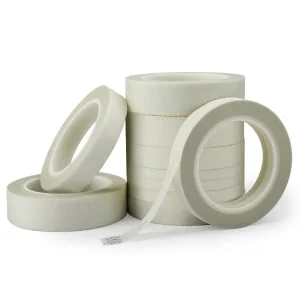
| Glass Cloth Tape (3M 69 Alternative) | Woven E-Glass Fabric | Thermosetting Silicone | Class H (200°C) | ≥ 400 N | Motor lead connection, dry-type transformer layer wrapping, plasma spray masking. |
| Unidirectional Filament Tape | Continuous Glass Rovings | Hot-Melt Synthetic Rubber | Class A (80°C) | ≥ 650 N | Heavy steel coil bundling, structural pipe grouping, appliance pallet stabilization. |
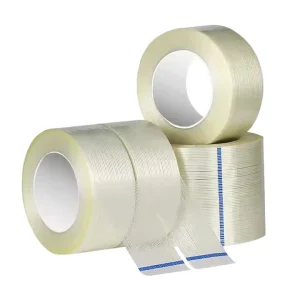
| Cross-Weave Bi-directional Tape | Grid Diamond Fiberglass Scrim | Reinforced Solvent Acrylic | Class B (130°C) | ≥ 500 N / Cross-Axis | High-stress hazardous goods packaging, oil & gas pipeline wrapping, air-cargo securing. |
| PET / Glass Fiber Composite Tape | Laminated PET Film + Yarn | Anti-Flagging Thermoset Rubber | Class F (155°C) | ≥ 480 N | Refrigeration condenser coil bonding, oil-filled distribution transformer winding. |
| High-Tack Double-Sided Filament | Fiberglass Mesh Matrix | Modified Pressure-Sensitive Acrylic | Class A-B (90°C–120°C) | ≥ 280 N | EPDM foam mounting, architectural acoustic panel lamination, structural automotive trim. |
Ensuring cross-border shipments adhere strictly to national electrical codes, environmental toxics restrictions, and continuous QA testing protocols.
Flame retardance is paramount in enclosed switchgear and EV battery chassis. Formulations undergo rigorous Bunsen burner vertical burn tests to prevent self-sustained ignition and self-extinguish within predetermined intervals, avoiding catastrophic electrical fire propagation.
Zero tolerance for restricted hazardous substances. Every production roll is SGS-tested for heavy metals (Lead, Mercury, Cadmium, Hexavalent Chromium), PBBs, PBDEs, and SVHC candidate list plasticizers, assuring seamless customs clearance across the EU, UK, and Americas.
From yarn roving weight check to raw solvent resin solids calibration, coating thickness gauges (infrared/beta ray continuous scanning) record dynamic variance across the web. Master rolls are serialized, allowing lifetime reverse audits down to slitted carton IDs.
Real-world failure prevention through optimized glass fiber carrier selection and precision slitting geometries.
The Challenge: A European rail equipment rebuilder suffered premature coil loosening in high-speed auxiliary motors under centrifugal stress and 160°C operating temperatures using standard polyimide tapes.
The Solution: Implemented Huayuan Glass Cloth Tape with Class H thermosetting silicone adhesive. The woven fiberglass backing prevented mechanical elongation, while the silicone adhesive cured during initial warm-up, creating an unyielding composite ring around the end windings without delaminating under varnish dipping.
The Challenge: An energy storage system (ESS) manufacturer faced battery cell expansion during deep discharge cycles, which caused standard packing tapes to snap and trigger short circuits.
The Solution: Engineered a custom-slit 400N unidirectional filament glass tape with solvent-resistant acrylic adhesive. The non-conductive, low-stretch properties stabilized the cell clusters indefinitely, reducing assembly reject rates by 99.4% and eliminating localized dielectric arcing.
The Challenge: Automated coil wrapping lines in metal processing mills encountered sheared tape edges from sharp coil corners during crane transfer and export oceanic transport.
The Solution: Deployed high-tack cross-weave fiberglass tape featuring high-density dual-axis glass yarn in an oil-resistant synthetic rubber system. The diamond pattern redistributed shear forces equally, stopping longitudinal splitting and resisting outdoor ambient humidity.
Pioneering advancements in low-VOC emissions, solvent-free hot melt extrusion, bio-derived resin backbones, and smart diagnostic sensor tapes.
Transitioning high-strength packaging and structural filament tape lines from aromatic solvent formulations to 100% solids UV-cured acrylic and hot-melt resins, slashing production carbon footprints by 42%.
Introduction of bio-derived silane coupling agents and plant-sourced synthetic resins within E-glass fabrics, maintaining UL 94 V-0 flame ratings while fulfilling European circular economy requirements.
Synthesizing boron nitride and aluminum nitride nanoparticles into the adhesive layer, permitting dual-action mechanical structural bundling and localized thermal dissipation in dense EV battery packs.
Embedding micro-optical fiber filaments directly into glass woven carriers for continuous strain, temperature, and partial discharge monitoring in offshore wind generator stators and deep-sea umbilical power cables.
In-depth responses for manufacturing plant buyers, electrical insulation engineers, and international procurement managers.
Founded in 2007 with modern manufacturing plants in Zhuhai and Zhongshan, Guangdong, Zhuhai Huayuan Electronics Co., Ltd. delivers world-class industrial pressure-sensitive adhesive tapes, glass cloth composites, and precision die-cut components to OEM buyers in over 60 countries. Request comprehensive test rolls, custom slitting configurations, and engineering consultations today.