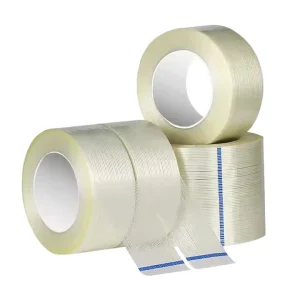
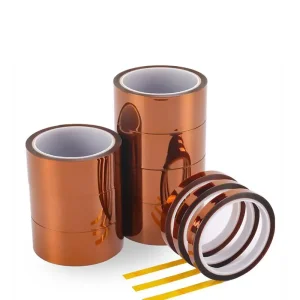
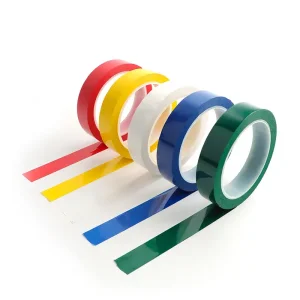
Manufactured under strict ISO 9001 quality controls in cleanroom coating environments, matching critical global tensile and thermal tolerances.
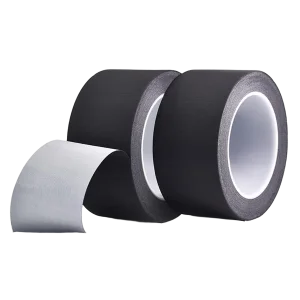
Addressing the microsecond mechanical thresholds in continuous roll manufacturing across flexible packaging, EV battery foils, and optical display fabrication.
Continuous conversion operations run at line speeds exceeding 800 m/min. Flying splices demand pressure-sensitive adhesives that display ultra-low glass transition temperatures (Tg) paired with immediate wetting dynamics. Polyester splicing tape engineered with modified crosslinked polysiloxanes achieves instant mechanical grab against silicone-treated release liners and polyolefin films, fully mitigating unthreading downtime.
Modern functional coatings subject the spliced substrate to severe downstream drying tunnels reaching up to 220°C, alongside aggressive organic solvent environments (MEK, Toluene, Ethyl Acetate). The biaxially oriented polyethylene terephthalate (BOPET) backing offers high dimensional stability, ensuring zero elongation and adhesive flow-out under extreme oven conditions.
In cleanroom slitting and automated electronics roll-to-roll (R2R) assembly, triboelectric discharge can destroy micro-circuitry. Our anti-static coated polyester tapes maintain surface resistivities of 10^8 to 10^10 Ω/sq. Simultaneously, optical sensors benefit from calibrated high-visibility pigments (standard yellow, vibrant blue, or deep red) to trigger automated downstream cutting stations without false positives.
| Performance Parameter | Standard Commercial Splicing Tape | Huayuan Cleanroom Precision Grade | Testing Protocol Compliance |
|---|---|---|---|
| Carrier Thickness (BOPET) | 23 µm - 25 µm (±10%) | 25 µm / 50 µm (±3% Cleanroom Calibrated) | ASTM D3652 / ISO 4593 |
| Adhesive Chemistry | Unmodified Synthetic Rubber / Basic Acrylic | High-Crosslinked Silicone / Modified Pure Acrylic | FTIR Polymer Characterization |
| Dynamic Shear (23°C, 1 kg) | > 4 Hours on standard kraft | > 72 Hours on Low Surface Energy (LSE) Liners | PSTC-107 / FINAT FTM 8 |
| Thermal Endurance (Continuous) | Max 120°C (Adhesive softening observed) | 180°C - 200°C Short-term (Zero residue transfer) | ASTM D4498 Thermal Fail Test |
| Surface Resistivity (ESD Grade) | Non-dissipative (> 10^12 Ω/sq) | 10^8 – 10^10 Ω/sq Controlled Dissipation | ANSI/ESD STM11.11 |
Ensuring compliance with international chemicals registries while providing end-to-end converter support across Europe, the Americas, and APAC.
For converters in Germany, France, and northern Europe, compliance with EU Regulation 1907/2006 (REACH) and SVHC restrictions is paramount. Huayuan certifies that all silicone and acrylic splicing grades are devoid of restricted plasticizers, heavy metals, halogenated flame retardants, and persistent siloxanes (D4/D5/D6 below threshold), complete with full SGS third-party screening dossiers.
Serving precision slitting and flexible packaging converters in the US and Canada requires adhesion compliance combined with safety certifications. Selected grades feature UL94 VTM-0 flammability listings for electrical electronics insulation. For dry-food indirect packaging applications, specific formulations pass FDA 21 CFR 175.105 adhesive migration thresholds.
International sourcing requires more than an FOB transaction. Huayuan provides custom slitting tolerance control (±0.25mm via German automated blade systems), custom core dimensions (1-inch, 3-inch, and 6-inch ABS/plastic cores for dust-free environments), and expedited cold-chain logistics options to prevent adhesive degradation during ocean freight transits through tropical shipping lanes.
How customized polyester splicing formulations resolve yield bottlenecks in critical production sectors.
The Challenge: Most pressure-sensitive tapes completely fail to adhere to low surface energy (LSE) cured polydimethylsiloxane (PDMS) liners.
The Solution: Our series uses crosslinked functional silicone pressure-sensitive adhesives that form dynamic chemical anchorage onto release liners, allowing continuous reel changeover in label stock and medical adhesive manufacturing without line arrest.
The Challenge: Splicing ultra-thin copper (6-9 µm) and aluminum foils during continuous slurry coating creates thickness bumps that damage doctor blades.
The Solution: Ultra-thin 15 µm to 25 µm PET backing paired with high-shear acrylic ensures splice joints pass through calenders without web breakage, resisting hot N-Methyl-2-pyrrolidone (NMP) solvent exposure.
The Challenge: Outgassing, fish-eyes, and gel particles cause optical contamination and air voids during roll lamination.
The Solution: Coated in Class 1,000 cleanrooms and slit in Class 100 laminar flow enclosures, our optical PET tapes maintain total optical clarity, low particle count, and stable unwind tension to eliminate optical defects on display sub-assemblies.
Anticipating structural regulatory shifts and machine speeds through next-generation adhesive research.
In accordance with global circular economy goals, Huayuan is standardizing backings with 30% to 50% Post-Consumer Recycled (PCR) PET without compromising mechanical tensile strength. Simultaneously, R&D trials for bio-derived acrylic adhesives replace fossil-based monomers, reducing the embedded carbon footprint of our converter clients.
Traditional silicone coatings require substantial thermal evaporation of organic solvents. Our secondary coating lines integrate 100% solids UV-curing technologies. This cuts VOC emissions to negligible levels, eliminates volatile extractables that could poison catalyst-sensitive processes, and delivers tighter peel force tolerance profiles.
Modern Industry 4.0 converting lines require automated roll history tracking. Huayuan's engineering unit is prototyping embedded ultra-thin aluminum conductive circuits and printable RFID layers directly within the polyester splicing sandwich, enabling automated web monitoring systems to detect splice passage and record batch metrics automatically.
Direct technical answers addressing the critical evaluation criteria of procurement directors and converting engineers.
Silicone release liners are treated with polydimethylsiloxane (PDMS), resulting in an extremely low surface energy (typically 20-25 dynes/cm) designed to repel most pressure-sensitive adhesives. Standard acrylic or rubber tapes cannot wet the surface and suffer shear failure. Splicing tape formulated with high-performance crosslinked silicone adhesives possesses matching surface tension characteristics, creating an immediate, aggressive intermolecular bond capable of holding web tension at speeds up to 1000 m/min.
Carrier thickness represents a direct trade-off between tensile modulus and flexural compliance. A thinner backing (e.g., 23-25 µm PET) provides superior conformability over nip rollers and lowers the profile bump as the joint traverses doctor blades or printing stations. Conversely, thicker films (50 µm to 75 µm) are required when transverse web tension is extreme, preventing edge tearing during the microsecond shock load of a high-speed flying splice.
Operating imported automated slitting machines equipped with laser-guided edge positioning, Huayuan provides slit width tolerances within ±0.25 mm. Available in standard 66-meter rolls up to 2000-meter continuous spool/traverse wound bobbins, our reels reduce spool changeover frequency on continuous production machinery. Inner cores are offered in 1-inch, 3-inch, and 6-inch diameters in plastic or low-dust paper composite.
Adhesive ooze (bleed) and core telescoping during oceanic transit are driven by thermal fluctuations and ambient humidity shifts. Huayuan utilizes proprietary polymer crosslinking that locks adhesive flow even when container temperatures reach 60°C in equatorial transits. Rolls are vacuum sealed with desiccant in heavy-gauge PE bags, suspended horizontally on end-boards, and palletized with reinforced plastic stretch wrapping to withstand axial movement.
Yes. Our analytical laboratory routinely performs reverse engineering via FTIR spectroscopy, peel adhesion dynamometers (PSTC-101), and dynamic mechanical analysis (DMA). We match exact backing gauge, adhesive grammage, peel profile, and shear resistance, providing full Technical Data Sheets (TDS), Safety Data Sheets (SDS), and side-by-side benchmarking reports alongside free evaluation sample rolls.
Explore our complete manufacturing matrix: High-viscosity VHB tapes, polyimide PCB films, thermal conductive interfaces, and double-sided mounting substrates.