Engineered for high-frequency electromagnetic compatibility (EMC), thermal grounding, and electrical dielectric isolation across automotive, telecommunications, and industrial automation assemblies.
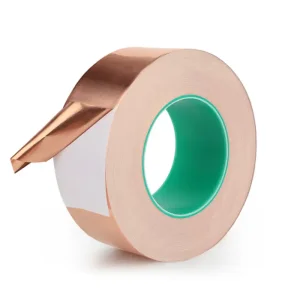
In high-density electronics, signal integrity is challenged by electromagnetic radiation, rapid thermal dissipation needs, and tighter form factors. China's thin copper foil tape manufacturing ecosystem provides high-purity metallurgical carriers and chemically balanced pressure-sensitive adhesives that meet these stringent engineering demands.
Thin copper foil tapes (ranging from 12µm to 50µm) provide high shielding effectiveness (>85 dB from 10 MHz to 10 GHz). Using rolled annealed (RA) copper foil alongside isotropic conductive acrylic matrices filled with nickel or silver-plated copper spheres, these materials offer low point-to-point contact resistance (below 0.05 Ω/sq), eliminating crosstalk across multi-layer high-density PCB stacks and optical transceivers.
Copper's bulk thermal conductivity reaches approximately 390 W/m·K. Thin copper foil tapes act as heat spreaders and electrostatic discharge (ESD) ground planes for OLED panels, smartphone camera image signal processors (ISPs), and LiDAR controllers. They route localized thermal hot spots outward while providing zero-potential grounding to chassis metal enclosures.
Unlike rigid enclosures, ultra-thin copper tapes flex around contoured geometries in wearable sensors and medical endoscopy probes without micro-cracking. Advanced acrylic cross-linking agents preserve cohesive tack and shield performance across temperature thermal swings from -30°C to +155°C, avoiding delamination or dielectric breakdown.
Global procurement teams prioritize cost stability, capacity scalability, and end-to-end quality consistency. Modern Chinese precision coaters, such as Zhuhai Huayuan Electronics, bring together chemical synthesis, high-speed slitting, and cleanroom converting under one roof.
Direct partnerships with domestic copper processing centers ensure access to ultra-clean 1/2 oz, 1 oz, and sub-gauge 9µm rolled copper foils. This vertical structure protects buyers from raw copper trading swings and slashes lead times on custom orders.
Class 1,000 to Class 10,000 dust-free workshops prevent airborne particulates on adhesive lines. Multi-knife shear slitters handle narrow tape cuts from 2.0 mm to log roll widths of 1200 mm without burrs, edge telescoping, or web waviness.
By blending localized engineering with automated coating heads, Chinese manufacturers offer performance comparable to Western suppliers like 3M 1181 or 3M 1245 at a fraction of the cost, improving margins on volume consumer electronics production.
Suppliers provide full PPAP Level 3 documentation, IMDS filings, and micro-caliper thickness profiles, ensuring full traceability from electrolytic smelting to final slitting.
A reference guide comparing standard thin copper foil tape constructions, backing treatments, and conductive pressure-sensitive adhesive (PSA) configurations.
| Classification Code | Backing Foil (Type / Thickness) | Adhesive System | Contact Resistance | Peel Strength (180° Test) | Operating Temp Range | Primary Industrial Use-Case |
|---|---|---|---|---|---|---|
| CFT-CU18-C | Rolled Annealed (RA) Copper / 18 µm | Conductive Acrylic (Ni-Spheres) | < 0.03 Ω/in² | > 9.5 N/25mm | -25°C to +130°C | Smartphones, FPC Grounding, Display Drivers |
| CFT-CU35-C | Electrolytic Tough Pitch (ED) / 35 µm | Dual-Sided Conductive Acrylic | < 0.02 Ω/in² | > 11.0 N/25mm | -40°C to +150°C | EV Battery Management Enclosures, MRI Rooms |
| CFT-CU25-NC | Rolled Annealed (RA) Copper / 25 µm | Non-Conductive Pure Acrylic | N/A (Backing Only) | > 12.5 N/25mm | -20°C to +120°C | Transformer Outer Wrap, Stained Glass Assembly |
| CFT-CU50-HT | Deoxidized Low-Phosphorus / 50 µm | High-Temp Silicone PSA | < 0.05 Ω/in² | > 8.5 N/25mm | -50°C to +200°C | Aerospace Cable Harnesses, Wave-Solder Grounding |
| CFT-SN-CU35 | Tin-Plated Copper Foil / 35 µm | Conductive Solvent Acrylic | < 0.015 Ω/in² | > 10.0 N/25mm | -35°C to +140°C | Galvanic Corrosion Prevention against Aluminum |
From cleanroom automated SMT pick-and-place lines to high-vibration aerospace cabins, thin copper foil tape serves as an essential functional component rather than just a simple adhesive film.
Applied within Battery Management System (BMS) enclosures to drain high-voltage inverter switching noise away from sensitive CAN-bus lines. Tin-plated variants protect against galvanic oxidation when bonded directly to aluminum cooling plates.
Micro-die-cut copper gaskets maintain tight RF shielding across aluminum die-cast antenna array enclosures. The low contact resistance of conductive acrylic formulations prevents signal leakage at high frequencies above 28 GHz.
Used to seal MRI chassis cabins, ultrasound transducers, and patient monitoring leads. Shielding prevents false signal artifacts caused by stray ambient Wi-Fi, 4G, or switch-mode power supplies.
Wrapped around outer transformer cores as a Faraday shield. It cancels common-mode capacitive noise between the primary and secondary windings, simplifying industrial power supply CE/FCC certification.
Reliable sourcing requires uncompromising adherence to environmental, safety, and manufacturing quality systems. Huayuan provides rigorous documentation to streamline vendor qualification audits.
Audited quality systems cover coating speed, solvent extraction, adhesive solids content, and curing chamber temperatures. Roll-by-roll tracking preserves peel and surface resistivity data for 36 months.
Select conductive copper foil grades hold UL 510 component recognition (File category OANZ2). These materials resist self-sustained combustion, meeting fire safety standards for consumer appliances and EV power converters.
Annual SGS testing verifies compliance with RoHS (Directive 2011/65/EU and 2015/863) and SVHC-REACH regulations. Formulations are free from polybrominated diphenyl ethers (PBDE), lead, cadmium, and mercury.
Huayuan International Technology (Hong Kong) provides overseas buyers with clear export contracts, rapid DDP/FOB shipments, and fast 24-hour technical responses with full TDS and MSDS packages.
The transition toward sub-nanometer semiconductor packaging, 800V silicon carbide (SiC) inverters, and high-frequency communication demands ongoing materials development.
Scaling up production of 6µm to 9µm rolled annealed copper foils for foldable OLED hinges and compact micro-camera modules, delivering flexibility without metallurgical fatiguing.
Applying nanoscale graphene layers over thin copper foils to elevate thermal dissipation beyond 600 W/m·K, easing thermal bottlenecks in edge AI processors and high-power transceivers.
Developing low dielectric constant (Dk < 2.5) adhesives to minimize parasitic capacitance losses in 6G communications running between 100 GHz and 300 GHz.
Transitioning from solvent recovery coating lines toward solvent-free UV-curable and bio-based acrylic adhesives, minimizing carbon emissions per square meter manufactured.
Key technical answers covering adhesive conductivity, metallurgical distinctions, and custom conversion capabilities.
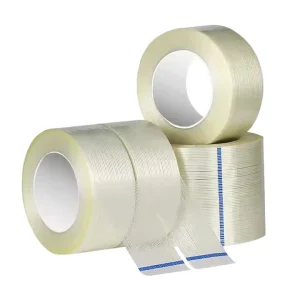
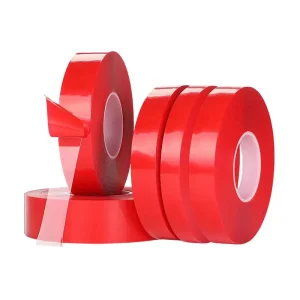
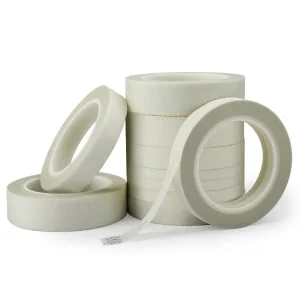
Explore our complete industrial adhesive lineup, spanning EMI shielding copper tapes, electrical-grade acetate cloth, high-tack VHB structural foams, and plating masking solutions.