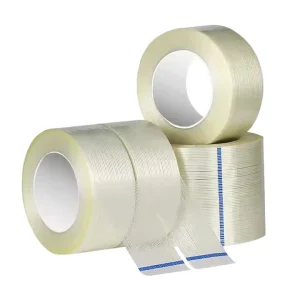
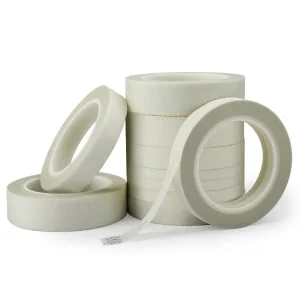
Direct manufacturer supply catalog showcasing high-performance industrial bonding, thermal conductive, and electrical insulation tapes calibrated for global manufacturing tolerances.
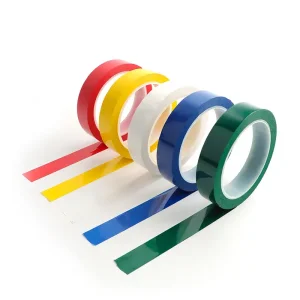
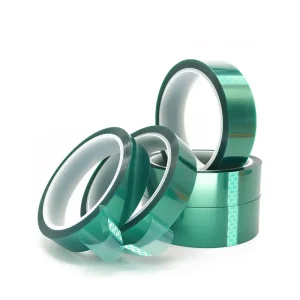
How polyimide electrostatic discharge technology mitigates microscopic dielectric failure across sub-micron semiconductor, aerospace, and energy storage production lines.
In modern industrial electronics manufacturing, standard polyimide (Kapton) films possess high insulation resistance but are susceptible to accumulating static electricity during unwinding, masking, and peeling. Triboelectric charges regularly exceed 5,000V to 10,000V upon tape peel from typical substrates—a catastrophic risk for sub-7nm semiconductor nodes, sensitive GMR recording heads, CMOS imaging sensors, and ultra-dense Printed Circuit Board Assemblies (PCBAs). ESD Kapton Tape (Electrostatic Discharge Polyimide Tape) resolves this critical vulnerability through molecular-level surface modification or carbon-nanotube/conductive-metal antistatic coatings applied to the back of the polyimide carrier or integrated directly into the crosslinked silicone adhesive matrix.
The global transition toward high-density interconnect (HDI) substrates, electric vehicle (EV) battery battery-management systems (BMS), and aerospace avionics has made ESD mitigation an indispensable quality metric rather than an optional specification. By keeping static unwind voltage under 50V and maintaining a stable surface resistivity between 106 and 109 Ohms/sq (dissipative range), ESD Kapton tape neutralizes catastrophic latch-up events and latent electrostatic defects that degrade equipment reliability in cleanroom environments.
Available in single-side conductive adhesive or double-side ESD configurations. Dissipates triboelectric charging rapidly during unwinding and high-speed robotic surface application without sparking or ground-loop disruptions.
Continuous thermal endurance from -73°C to 260°C (-99°F to 500°F) with short excursions up to 300°C during lead-free wave soldering, SMT reflow ovens, and harsh chemical masking baths.
Specially synthesized high-purity pressure-sensitive silicone adhesives leave non-detectable ionic contamination, outgassing traces, or gummy deposits on gold fingers and ceramic packages post-stripping.
Combining Zhuhai and Zhongshan cleanroom infrastructure with localized polyimide precursor integration to achieve unmatched cost-to-performance benchmarks.
China's Pearl River Delta manufacturing corridor represents the pinnacle of tape coating automation, raw material clustering, and high-precision converting capabilities. At Huayuan Electronics, operating out of Nanping Science & Technology Park in Zhuhai and our Tanzhou base in Zhongshan, the integration of advanced continuous-feed coating lines, closed-loop tension control rewinders, and Class 1,000 cleanroom environments delivers significant efficiency gains over fragmented overseas supply chains.
Direct access to regional polyimide synthesis centers, combined with in-house organosilicon adhesive compounding, ensures rigorous viscosity consistency and batch-to-batch polymer integrity. This vertical mastery drives down lead times from the traditional 8–10 weeks observed in western markets to just 7–14 days for custom OEM formulations, while minimizing web thickness variance to within ±0.002mm.
| Property Parameter | Test Standard | Standard Polyimide Tape | Huayuan ESD Kapton Tape |
|---|---|---|---|
| Carrier Substrate | ASTM D374 | Polyimide Film (0.025mm) | Antistatic-Treated Polyimide (0.025mm) |
| Adhesive System | Internal Spec | Thermosetting Silicone (0.040mm) | Ultra-Low Outgassing ESD Silicone |
| Total Thickness | ASTM D1000 | 0.065mm ± 0.005mm | 0.060mm – 0.065mm ± 0.002mm |
| Backside Surface Resistivity | ASTM D257 / ESD S11.11 | > 1012 Ω/sq (Insulative) | 106 – 109 Ω/sq (Dissipative) |
| Peel Static Voltage | MIL-STD-1686C | > 3,500 V – 7,000 V | < 50 V |
| Adhesion to Steel (180°) | ASTM D3330 | 5.5 – 6.5 N/25mm | 5.0 – 6.5 N/25mm (Clean Peel) |
| Dielectric Breakdown Voltage | ASTM D149 | 5.0 kV | ≥ 5.5 kV |
| Operating Temperature | UL 510 | -40°C to 200°C | -73°C to 260°C (300°C Peak) |
Analyzing application scenarios and upcoming technological evolutions shaping ESD-safe masking and component packaging.
Protects gold fingers, surface mount components, and contact edge pins during dynamic solder dip operations without risk of triboelectric damage during high-speed automated removal.
Applied to prismatic and pouch lithium-ion battery cells, busbar connections, and thermal runaways barriers where flame retardancy (UL94 V-0) and electrostatic suppression are mandatory.
Secures wafers, integrated passive devices, and micro-electromechanical systems (MEMS) in vacuum chambers, preventing airborne dust attraction and ESD dielectric puncture.
Provides critical wire harness wrapping and thermal insulation blankets in high-radiation, zero-atmosphere settings without static charge build-up or silicone outgassing contamination.
Tier-1 automotive electronics manufacturers, cleanroom contract assembly providers (EMS), and semiconductor foundries have raised procurement criteria beyond simple tensile specs. Current vendor audit frameworks require verifiable ISO 9001:2015 tracking, third-party SGS RoHS/REACH compliance documentation, halogen-free formulations (<900 ppm Cl/Br), and documented ESD life spans that resist degradation under high-humidity (85°C/85% RH) testing cycles. Huayuan meets these rigorous audit standards directly from our South China manufacturing centers.
Detailed technical, compliance, and supply chain answers compiled by Huayuan’s senior application engineering team.
Standard Kapton (polyimide) tape is an exceptional electrical insulator but generates high static voltage (>5,000V) upon rapid unwind due to tribocharging. ESD Kapton tape incorporates a specialized conductive/dissipative coating that restricts unwinding and peel static to <50V while maintaining surface resistivity in the optimal 106 to 109 Ω/sq dissipative range.
No. Huayuan’s proprietary ESD treatment uses crosslinked organometallic or carbon-nano matrix layers permanently bonded to the polyimide backing. It withstands peak soldering exposures of 260°C to 300°C for up to 60 seconds without losing dissipative continuity, flaking, or altering adhesive peel resistance.
Yes. Equipped with high-precision optical die-cutting machinery and class-1000 cleanroom slitting equipment, we supply log rolls, custom widths from 2mm to 1000mm, and custom kiss-cut shapes with release liners or pull tabs designed specifically for automated pick-and-place surface mount equipment.
Every shipment is covered by batch-specific Certificates of Analysis (COA). Our manufacturing operations conform strictly to ISO 9001:2015 standards, and all polyimide formulations comply with EU RoHS, REACH, and UL 510 flame retardancy requirements with independent SGS laboratory test reports provided upon request.
We synthesize our pressure-sensitive silicone adhesives in-house with precisely calibrated crosslinking catalysts. This eliminates unreacted low-molecular-weight siloxanes, preventing oil creep or residue transfer to copper, immersion gold (ENIG), or ceramic packages, confirmed via FTIR surface spectroscopy after 260°C thermal exposure.
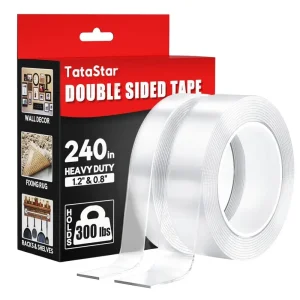
Specialized double-sided, glass cloth, and specialty adhesive products engineered for industrial assembly, insulation, and electronics manufacturing.