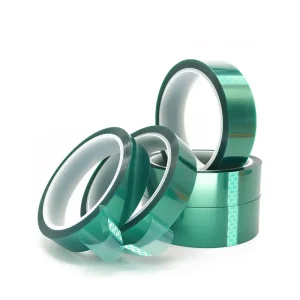
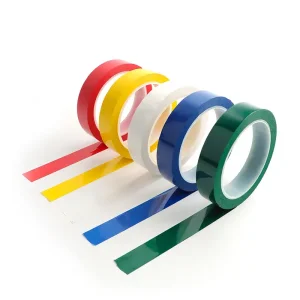
Engineered for mission-critical electrical insulation, thermal dissipation, and industrial mounting applications across tier-one manufacturing ecosystems.
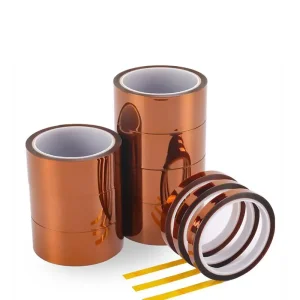
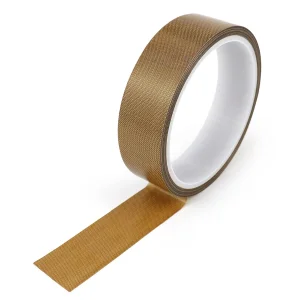
Analyzing structural supply chain shifts, polymer manufacturing economics, and China's strategic transition into high-spec polyimide film conversion.
Polyimide (PI), historically commoditized under DuPont's registered trademark Kapton, occupies an irreplaceable apex position in the hierarchy of high-performance polymer engineering. Characterized by repeating imide rings along its backbone, aromatic polyimide exhibits zero glass transition temperature ($T_g$) below thermal degradation (>380°C), near-zero outgassing in ultra-high vacuum environments, and mechanical stability down to cryogenic depths (-269°C).
Over the past decade, global procurement matrices have transformed dramatically. While multinational original equipment manufacturers (OEMs) historically depended entirely on North American and Japanese chemical synthesizers (DuPont, Kaneka, Toray, SKC Kolon), China's high-tech manufacturing sector has engineered a systemic capability leap. Operating out of specialized industrial corridors—such as the Pearl River Delta industrial cluster where Zhuhai Huayuan Electronics Co., Ltd. has expanded production across Zhuhai and Zhongshan facilities—leading Chinese converting factories now formulate advanced polymer backings, synthesize specialized silicone/acrylic pressure-sensitive adhesive (PSA) formulations, and deliver cleanroom-manufactured polyimide tapes meeting rigorous ASTM, IEC, and military specifications.
This capacity transition is not merely cost-driven; it is fundamentally an engineering flexibility and lead-time revolution. Where legacy Western suppliers enforce 16 to 24-week allocation windows with rigid MOQs, tier-one Chinese factories deliver customized multi-layer laminates, exact slit widths down to 1.5mm, and specialized low-static discharge (anti-static ESD) variants with 48-hour prototype cycles and certified compliance documentation (RoHS, REACH, halogen-free, and UL 94 V-0).
Understanding the molecular-level interactions governing mechanical shear, high-temperature dielectric stability, and adhesive-to-film cross-linking.
The foundational carrier film is synthesized through the polycondensation of an aromatic diamine (4,4'-oxydianiline, ODA) with an aromatic dianhydride (pyromellitic dianhydride, PMDA) inside a polar solvent such as Dimethylacetamide (DMAc). This produces intermediate Polyamic Acid (PAA).
Thermal cyclodehydration (imidization) above 300°C closes the heterocyclic imide rings, rendering the film chemically inert, thermally stable, and resistant to virtually all organic solvents, aliphatic hydrocarbons, and battery electrolytes.
Untreated polyimide exhibits very low surface free energy, often below 38 dynes/cm, which challenges typical pressure-sensitive adhesives. High-performance factories employ controlled inline corona discharge or chemical primers (organosilane or titanate-based) prior to silicone or acrylic coating.
For high-heat electrical applications, polydimethylsiloxane (PDMS) networks cross-linked via platinum or peroxide catalysts bond firmly, preventing adhesive transfer even during molten solder exposure.
Standard polyimide generates electrostatic potentials exceeding 5,000V upon unrolling, presenting catastrophic risks to sensitive semiconductors (MOSFETs, GMR heads). High-spec Chinese suppliers formulate dual-sided ESD coatings incorporating nano-carbon or conductive polymers.
This yields surface resistivities of 106 to 109 ohms/sq, reducing peel tribocharging below 50V to preserve ultra-dense SMD circuit integrity during automated pick-and-place high-speed lines.
| Property / Engineering Metric | Test Standard | Standard Polyimide (Huayuan Grade) | DuPont™ Kapton® HN Baseline | Functional Sourcing Significance |
|---|---|---|---|---|
| Nominal Base Film Thickness | ASTM D3652 | 25 µm (1.0 mil) / 12.5 µm / 50 µm | 25 µm (1.0 mil) | Space-constrained EV battery cell envelopes and FPC spacing |
| Tensile Strength at Break | ASTM D882 | ≥ 195 MPa (MD/TD) | 231 MPa (MD) | Prevents web rupture on high-speed automated winding machines |
| Dielectric Breakdown Voltage | ASTM D149 | ≥ 6.5 kV (25µm film + 35µm PSA) | 7.5 kV / mil | Prevents arc-over and corona breakdown in Class H motors & inverters |
| Peel Adhesion to Stainless Steel | ASTM D3330 | 6.0 – 8.5 N / 25mm | 6.5 – 8.0 N / 25mm | Maintains conformal contact without edge flagging or adhesive residue |
| Thermal Operating Range | IEC 60085 | -40°C to +260°C (300°C Peak) | -269°C to +400°C | Withstands lead-free wave soldering (SAC305 reflow profile) |
| Electrolyte Immersion Stability | 1M LiPF6 in EC:DMC (60°C/30d) | No swelling, zero adhesive release | Inert | Imperative for lithium-ion cell pouch and prismatic tab anchoring |
| Outgassing (CVCM / TML) | ASTM E595 | < 0.05% CVCM / < 0.8% TML | 0.02% CVCM / 0.54% TML | Prevents optical degradation in aerospace & semiconductor vacuum chambers |
From high-temperature electronics masking to electric vehicle battery safety and aerospace cryogenics.
In prismatic, cylindrical (4680, 21700), and pouch lithium-ion cells, polyimide tapes perform critical insulation functions at the battery tab, busbar connections, and electrode edge terminations. Because the tape resides inside the sealed cell or module envelope, it must resist chemical degradation from aggressively corrosive organic carbonates (ethylene carbonate, dimethyl carbonate) containing dissolved LiPF6 salt.
Huayuan's electrolyte-resistant polyimide tapes utilize specialized high-purity acrylate or thermoset silicone adhesive networks that display zero fluorinated ion leachables, preventing internal micro-shorts and resisting thermal runaway propagation up to 300°C.
During surface mount technology (SMT) wave soldering and hot air solder leveling (HASL), vulnerable edge card connectors and gold fingers must be masked from molten solder alloys operating between 245°C and 265°C.
Polyimide masking tapes guarantee high conformability to prevent solder under-bleed, combined with clean peel release upon cooling. Advanced polyimide backings prevent silicon transfer (silicon ghosting), which otherwise causes solder voids, wetting failure, or electrical contact resistance on mission-critical circuit boards.
Modern electric traction motors, heavy-rail locomotives, and wind turbine generators operate under high voltage-stress conditions and elevated thermal envelopes. Polyimide tape serves as phase insulation, slot liner reinforcement, lead wire taping, and magnetic coil winding barrier.
Class H (180°C) and Class N (200°C+) rating compliance ensures the dielectric barrier does not embrittle or experience partial discharge erosion under prolonged thermal-mechanical vibration stresses.
Multi-Layer Insulation (MLI) blankets used in satellites, space probes, and cryogenic hydrogen storage tanks require aluminized polyimide films for thermal radiation containment. Polyimide withstands ionizing gamma radiation, deep-space ultraviolet degradation, and thermal extremes ranging from -269°C liquid helium immersion to +400°C orbital solar exposure.
Strict adherence to ASTM E595 outgassing limits prevents condensable volatile materials (CVCM) from fogging satellite optical sensors or photovoltaic solar arrays.
Anticipating structural material demands driven by 6G communications, foldable optoelectronics, and micro-semiconductor packaging.
Transition from standard 25µm films to 7.5µm and 12.5µm high-modulus polyimide carriers. Crucial for ultra-dense 3D semiconductor packaging and wearable flexible electronics without compromising breakdown voltage.
Elimination of the traditional amber tint via fluorine-containing monomers (FDA/6FDA) to produce Colorless Polyimide (CPI). Features optical transmission >90% and haze <1% for flexible OLED cover windows and solar backsheets.
Engineering porous or fluorinated polyimide matrices exhibiting dielectric constants (Dk) <2.8 and dissipation factors (Df) <0.002 at 28–60 GHz mmWave frequencies, essential for 5G-Advanced and 6G phased-array antennas.
In-situ hybridization of oriented boron nitride (h-BN) and carbon nanotubes within the polyimide matrix, lifting in-plane thermal conductivity from 0.2 W/m·K to >2.5 W/m·K while maintaining robust electrical isolation.
Historically, the wet-casting synthesis of polyimide emitted notable volatile organic compounds through the evaporation of DMAc or NMP solvents. Huayuan Electronics and leading Chinese advanced material institutes are advancing the closed-loop recovery of polar solvents via high-efficiency distillation units achieving >98.5% solvent recycling efficiency. Simultaneously, hot-melt and radiation-curable PSA systems are supplanting conventional solvent-borne adhesives, dramatically decreasing the carbon footprint per square meter of tape and ensuring flawless compliance with increasingly stringent EU Corporate Sustainability Due Diligence Directives (CSDDD).
Translating material chemistry into repeatable mass production via state-of-the-art coating lines, Class 1,000 cleanrooms, and ISO 9001 certified QA controls.
Founded in 2007, Zhuhai Huayuan Electronics operates modern manufacturing hubs across Nanping Science & Technology Park (Zhuhai) and Tanzhou Town (Zhongshan). This dual-base geographic architecture ensures high manufacturing redundancy, robust capacity reserves, and direct access to the Greater Bay Area export infrastructure via Hong Kong and Shenzhen.
Our high-speed comma and micro-gravure coating lines operate in enclosed Class 1,000 and Class 10,000 cleanroom environments. Automated beta-gauge radiation scanning continuously measures coating thickness across the 1,040mm master web width, maintaining dry adhesive tolerances within an uncompromising ±1.0 µm.
Operating beyond bulk log rolls, our conversion plant features high-precision rotary die-cutters, CCD visual inspection slitters, and automated packaging lines. We fabricate custom-geometry discs, pre-cut gold finger masking tabs, and complex multi-layer laminates with pull-tabs on fluorosilicone release liners tailored to high-speed pick-and-place lines.
Crucial technical answers for quality assurance teams, sourcing engineers, and supply chain managers.
"Kapton" is DuPont's registered trade name for its aromatic polyimide film based on PMDA-ODA chemistry. High-tier Chinese manufacturers utilize identical condensation polymerization chemistry to formulate polyimide backings with matching physical, mechanical, and dielectric metrics. The primary differentiator lies in the pressure-sensitive adhesive (PSA) formulation, coating uniformity, and conversion quality, where certified Chinese factories provide equivalent performance at substantial cost and lead-time advantages.
High-temperature polyimide masking tapes use fully cross-linked poly-dimethylsiloxane (PDMS) networks enhanced with silicone resins (MQ resins). This creates high cohesive strength. When anchored to the polyimide base film via inline corona treatment or organofunctional silane primers, the adhesive's internal cohesive strength and interfacial bond exceed its surface adhesion to gold or copper, enabling clean, zero-residue peeling after thermal exposure.
Yes, provided it is explicitly formulated for battery tab and cell insulation. Standard polyimide tape with general-purpose silicone adhesive can contaminate electrolyte chemistry. Battery-grade polyimide tapes feature specialized acrylate or thermoset silicone adhesives tested against aggressive 1M LiPF6 carbonate solvents to prevent swelling, adhesive detachment, or metallic ion leaching that could induce internal cell degradation.
Standard polyimide is an exceptional electrical insulator, which causes it to accumulate significant static charge when unwound. For ESD-sensitive areas, we engineer Anti-Static (ESD) Polyimide Tapes. By applying a conductive nano-coating to the backing and modifying the adhesive matrix, surface resistivity is maintained at 106 – 109 Ω/sq, limiting unrolling discharge voltage to <50V.
Utilizing CNC circular-blade automated slitting systems, Huayuan provides precision slitting widths from 1.5mm up to 1,000mm with edge tolerances controlled within ±0.1mm (and ±0.05mm on custom die-cut parts). Rolls are wound on 3-inch (76mm) or 1-inch plastic/paper cores with high edge straightness to prevent telescoping or edge distortion on high-speed automated dispensers.
When stored in original packaging at 20°C–25°C and 50–60% relative humidity, polyimide tapes with silicone adhesives have a certified shelf life of 12 to 24 months from production. Unlike rubber adhesives, silicone networks do not undergo oxidative embrittlement or degradation under controlled storage environments.
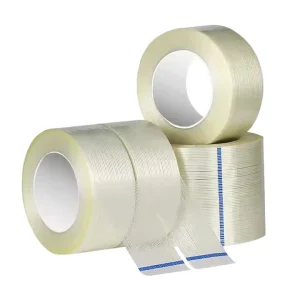
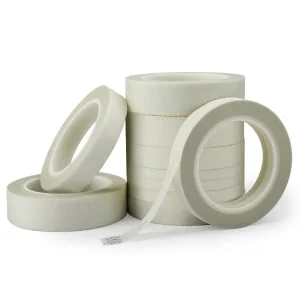
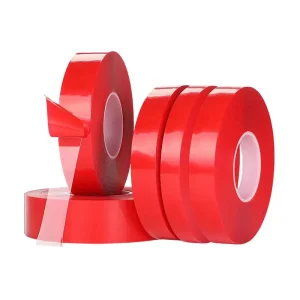
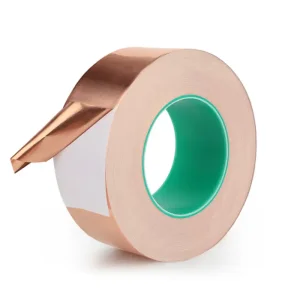
Explore our full converting portfolio: EMI copper shielding, fiberglass insulation, high-viscosity VHB foam, and custom adhesive laminates.